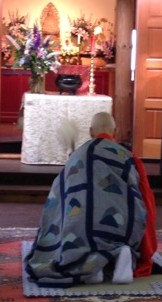
Rev. Taihaku bows during Mountain Seat Ceremony.


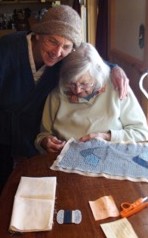
Taihaku-San, soon-to-be Abbot, shares a moment of gratitude to the oldest sewer, Connie, Taihaku’s 97 year old mother. Even with aging eyesight, Connie participated in the cutting of thread, ironing of waxed thread, appliqué of mountains and even the long lines of zokin-zashi (cleaning cloth) stitch.

Shao Shan Temple Prepares for Mountain Seat Ceremony
The custom when holding a Mountain Seat ceremony at a Zen Center to install a new abbot or abbess is for the sangha to sew a special okesa. The robe is presented and then worn during the ceremony (and later is only worn while teaching the Dharma, giving precepts, or presiding at other ceremonies). While the usual number of panels for the robe worn by priests for meditation (zazen), has 7 panels, this robe has at least 9 panels (and up to 25 panels). While always lined, if also made of layers of all found cloth sewn together with many rows of small stitches, this may include stylized mountains (toyama--these are only allowed on okesa). This is what the Shao Shan Temple chose to sew for the Mountain Seat Ceremony under the guidance of their sewing teacher. This would be the first such ceremony at Shao Shan, and was held on September 15, 2013. Here is their story.
Our journey of preparation for this special day began as a natural outcome of the growth of our teacher and sangha. The effort made has continued to sustain our practice well past the day of celebration. While the path to this event began decades before, the idea of becoming Abbot was not what Rev. Taihaku had imagined as the eventual outcome of her practice (“Abbot” may refer to either a man or woman).
When Suzuki-roshi was still alive, Rev. Taihaku (Gretchen Priest) practiced with him in San Francisco. In 1971 he sent her to Japan to study Buddhism at the Soto School’s Eiheiji Monastery’s Tokyo branch temple. The head of this zendo was Shinkai Tanaka, (who in 1997 became the head of Hokyoji priest training monastery in Fukui, Japan). Rev. Taihaku trained there and received priest ordination [? shiho] from Rev. Tanaka in the Soto School Order (date?).
In XXXX, Rev. Taihaku returned to the USA and began providing Zen practice, dharma study, regular retreats and ceremonies at Shao Shan Temple in Woodbury, Vermont. She later ordained her first priest, Kenzan Lee Seidenberg, who had matured in his practice over the years and was now ready to graduate from novice to full priest. When Rev. Taihaku began to explore how this could happen, she learned that this would be a very big undertaking: the Soto Order of Japan required that she host a three-month practice period (ango) and be installed as Abbot. Additionally, there was the need for sewing the special robe. Fortunately, they had two years to prepare.
Kenzan had trained Donna O’Malley in rakusu sewing, but okesa sewing was new for her. Nonetheless, when asked to lead the sewing, she replied “yes!” and the journey through many unknowns began. Through the network of sewing teachers and the Suzuki-roshi lineage Zen Centers, including Blanche Hartman at San Francisco Zen Center and Susan Jion Postal at Empty Hand in New Rochelle, New York (and with the aid of the internet), Donna found her way to Yuko Okumura of Sanshinji in Bloomington, Indiana, and Jean Selkirk, of Berkeley Zen Center. As told in the Great Ocean Robe story, Yuko and Jean had led the sewing of this robe by many people all over the country to present to Blanche Hartman for her many years of devotion to sewing Buddha’s Robe.
Because this robe would include the dying of found cloth, Jean also connected Donna with Anita Swann for guidance as she was working on a similar robe. Donna was able to travel to Brooklyn to meet with Anita and train in the sewing techniques. Meanwhile, Jean worked with Donna on the patterns and directions, exchanging many emails over the course of the next two years.
As Donna related: “we did not imagine what it would take, we simply stepped in.” While only in the process of those two years of preparation did the sangha realize what was needed to host the combination of three-month ango, Mountain Seat Ceremony, and first shiho (transmission of the dharma and authority to teach), the Shao Shan students and many others participated enthusiastically. Everyone could experience the vitality of connection to the lineage through making this special robe that would clothe Rev. Taihaku, and be bequeathed to future abbots of Shao Shan.
In saying “yes”, the creation of this robe already had begun. As seen in the accompanying images, many hours of time were offered. With the untold number of stitches sometimes a fair amount of head-scratching occurred (and even more email were exchanged). With the help of many hands and hearts across the country entering into this stream of stitches offered with the Namu Kie Butsu (“I take refuge in Buddha”) mantra, at this little country temple nestled in the tall red pines of Vermont, the robe continues to be a reminder of how the sangha joined together in this devotional practice of chanting and sewing. Ceaselessly, Big Mind’s expression is created through needle, thread, and mantra.
link shaoshan
© 2026 Zen Buddhist Sewing Teachers