
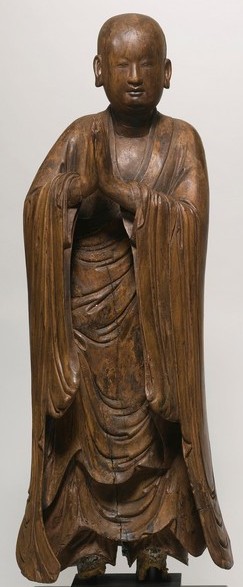
Wooden carving of Ananda, Ming Dynasty (1368 - 1644). The rice field pattern was painted on at one time, see below for example. (1)
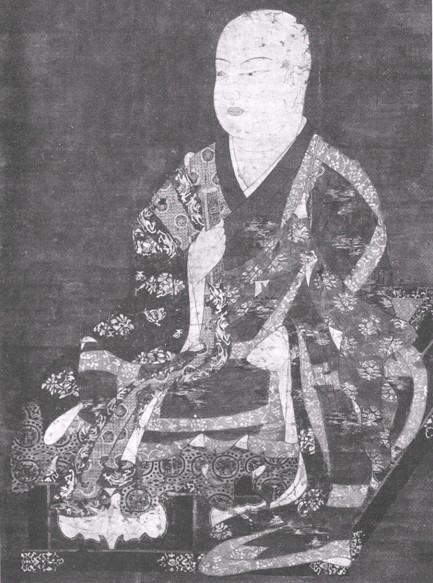
Japanese monk, late 16th/early 17th century). To right, representative sample of brocade sewn into robe. While this could be donated cloth, highly patterned and colorful, plainer cloth is more often worn today. (3)
(1) http://www.sothebys.com/en/auctions/ecatalogue/lot.23.html/2013/footsteps-of-the-buddha-n09007
(2) “Return of the Buddha: the Qingzhou discoveries”, Royal Academy of Arts, 2002.
(3) “The Elegance of Japanese Monks’ Robes” 1996, Art Gallery of Greater Victoria, B.C.
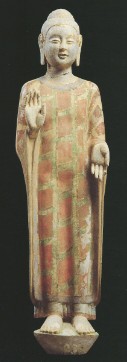
Earlier Chinese statue of Buddha, Qi Dynasty (550 - 557). Painted patchwork robe pattern was preserved when statue, damaged, was ritually buried. (2)
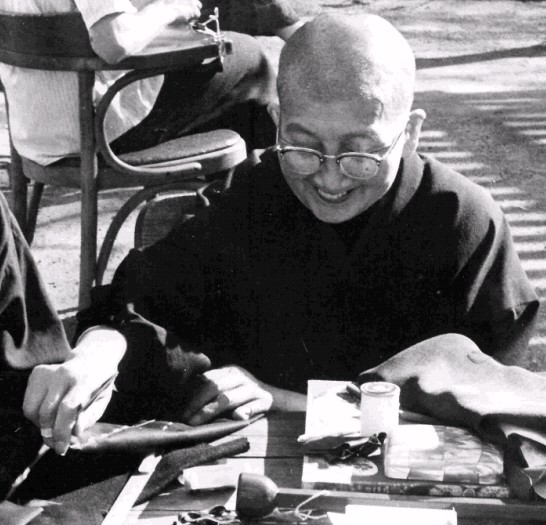

Eshun Yoshida- roshi at SFZC sewing sesshin, 1972.
Joshin-san
at Tassajara.

In the time of the Buddha, his monks wore robes of discarded or donated cloth. Their only other possessions were two additional robes (enough to keep warm at night), the belt to secure them, a bowl to eat from, a mat to sit upon for meditation, needle and thread to repair the robes, a razor for shaving, and a strainer for water so they could avoid killing any living beings when they drank the water.
One of the Buddha’s lay followers wanted to be able to distinguish the Buddha’s monks from other mendicant monks, because their robes all looked very similar. He asked the Buddha if their robes could have a distinguishing feature. So, one day when the Buddha was walking by a rice field with his disciple Ananda, the Buddha asked Ananda if it would be possible to make pieces of cloth into a pattern that looked like a rice field, with the water flowing through rice beds, surrounded by pathways. Ananda did just as the Buddha asked. The Buddha then asked his followers to find cast-off cloth that no-one else wanted for these robes, then discard what was not useable and wash the whole parts. Robes are still made today using the same pattern. Stories about the origin of the robes are found in the Buddha’s teachings recorded after the Buddha died called the Vinaya.
Since then, over the 2500 years of Buddhism, robes evolved as Buddhism moved eastward from India through China to Japan, and finally to the West. The appearance of robes in different times and places was responsive to local needs, yet was always sewn to incorporate the rice-field pattern in the construction. Even those robes that appear all of one piece, such as the bright yellow robes worn in Southeast Asian traditions, these are still made so that they represent the patchwork pattern Ananda devised.
When Buddhism reached Japan, and was adopted as the national religion by its ruler Prince Shotoku (~600 c.e.), robes worn reached new levels of ornateness in accordance with court dress and styles. While simpler versions of robes were still being worn and made, after more than a millennium of this trend continuing, one Buddhist priest, Jiun Onko (1718-1804), felt he should consult the Vinaya and return to authentic teachings about how to sew the patchwork robe.
Other disciples in his tradition continued the practice. 100 years after Jiun Onko’s death, in ~1906, a priest studying in the town of Nara saw three nuns wearing robes they had sewn in the manner Jiun Onko taught. This visiting priest was Sawaki Kodo (later called “roshi” meaning “venerable teacher”), a follower in the Dogen tradition of Soto Zen. He felt moved by his experience of seeing these robes and decided to learn how to sew them. Eko Hashimoto-roshi also learned to sew this style of robe. They each passed along these teachings to their disciples: Hashimoto-roshi to Yoshida Eshun-roshi, and Sawaki-roshi to Kaisai Joshin, a nun, and also Kyuma Echu-roshi.
Meanwhile, Shunryu Suzuki-roshi had traveled in 1959 from Japan to San Francisco. He believed Americans would be receptive to zazen, seated meditation, an activity considered to express enlightenment. Soon, many people began to sit zazen with him. He suggested to one female student that she travel to Japan to practice in a monastery for women. This was Kaizenji, Eshun Yoshida-roshi’s temple. By 1970 what she had heard from the student made her decide to visit America to see what was happening there. Over that visit and again in 1971, assisted by Tomoe Katagiri, with Katagiri-roshi’s support, she taught how to sew these robes and the tradition of sewing in accordance with the Buddha’s teachings.
Yoshida-roshi and Katagiri-roshi also convinced Suzuki-roshi to start giving the precepts (guidelines for living compassionately by vow) not just to ordained priests but also to lay people. This ceremony of ordination includes the teacher giving a robe sewn by the student to the student. In 1971, Suzuki-roshi, assisted by Katagiri- roshi, gave the precepts to over 50 lay people who had sewn the small version of the robe, called “rakusu.” Both priests and lay people wear this, and the priests also began sewing by hand the large robe called “okesa”.
The Katagiris moved to Minneapolis in 1972. Minnesota Meditation Zen Center was founded where Tomoe-san continued the sewing tradition until she retired in 2012. Yoshida-roshi could not return to the USA to continue teaching. Joshin-san then began visiting annually at San Francisco Zen Center in 1973 for nearly ten years, helping many people with their robes while passing the sewing tradition to a few. These included Zenkei Blanche Hartman who continued to follow Joshin-san’s teachings and devotion to Buddha’s Robe. Blanche had learned from her the practice of faith. By 2014 Blanche’s mobility had decreased and she passed away several days after she turned 90 in 2016, but her dedication to teaching others over the years allows the practice to continue.
Today, the many sewing teachers Blanche and Tomoe-san trained since 1970 have had an historic and continuing working relationship with organizations, students, and dharma teachers they serve; this group of sewing teachers is now formalized through the founding of Zen Buddhist Sewing Teachers.
History of Sewing Buddha’s Robe
© 2026 Zen Buddhist Sewing Teachers